In the heart of Tokyo’s bustling streets, where technology, tradition, and constant motion coexist, an unexpected display of intelligence unfolds daily—crows in Tokyo drop nuts on roads, patiently waiting for passing cars to crack them open. This clever behavior has not only fascinated scientists and birdwatchers but has also raised important questions about animal intelligence and urban adaptation.
Though it may sound like the plot of a nature documentary, this behavior is real, observable, and increasingly common in Japan’s capital. These crows aren’t merely scavengers—they are skilled problem solvers who have found a way to use the human environment to their advantage.
Crows in Tokyo drop nuts on roads: Not Just Urban Birds
Crows are often misunderstood creatures, seen by some as noisy nuisances or omens of bad luck. However, the crows in Tokyo are proving to be some of the smartest animals in the city. Known locally as karasu, these birds belong primarily to the species Corvus macrorhynchos, or large-billed crows. These are not the average birds one might see fluttering through a cityscape. They are robust, observant, and incredibly adaptable.
Their growing population in Tokyo has led to both admiration and concern. While many city residents are wary of their scavenging habits and aggressive behavior, researchers and nature enthusiasts are increasingly drawn to their intelligence—especially when observing how crows in Tokyo drop nuts on roads with seemingly calculated intent.
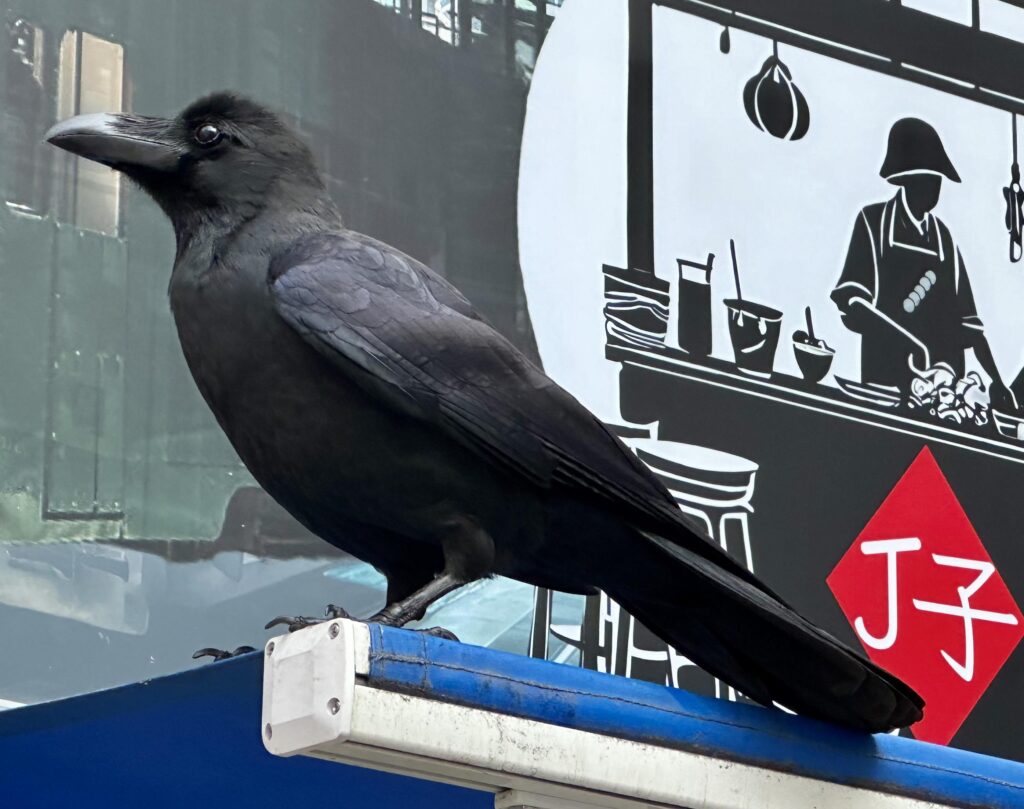
Nut-Cracking by Traffic: A Brilliant Adaptation
This specific behavior—dropping nuts onto busy streets and waiting for cars to roll over them—is perhaps the most famous example of crow intelligence in Japan. The concept is simple, but its execution reveals much more. The crows find hard-shelled nuts, often from ginkgo trees, that are common in Tokyo’s parks and sidewalks. Instead of struggling to break them open with their beaks, they fly to traffic intersections and drop the nuts in front of moving vehicles. After a car crushes the nut, the crow waits for a break in traffic, then swoops down to safely collect the exposed edible core.
Some crows have even learned to drop nuts near pedestrian crossings, using traffic lights to time their movements. They’ll wait for the red light to stop cars, place the nut strategically, and then wait again for the light to change and a vehicle to crush the shell. This clever use of human systems shows an astonishing level of spatial awareness, memory, and observational learning. The fact that crows in Tokyo drop nuts on roads not randomly but with purpose and timing suggests an understanding of patterns—something once thought to be limited to primates and humans.
A Window into Avian Intelligence
The actions of these crows are not isolated incidents. Researchers from around the world have taken an interest in the urban crow populations of Japan. In studies comparing corvids (the bird family that includes crows, ravens, and magpies), Tokyo’s crows have ranked among the most intelligent. What makes this even more remarkable is that this behavior isn’t learned from humans—it’s developed and passed along through crow communities. Young crows observe adults performing the nut-dropping strategy and eventually imitate it. This form of social learning is a trait rarely seen outside of advanced mammals.
This is why the observation that crows in Tokyo drop nuts on roads is not just a fun urban anecdote but a signpost in the study of bird cognition. It invites deeper questions: How do these birds perceive human structures? What else are they learning from the cities they live in? In a way, Tokyo has become an open laboratory, and the crows are some of its most promising researchers—showing us new layers of intelligence in unexpected places.
City Birds or Co-Inhabitants?

As Tokyo’s crows grow in number and skill, city planners have had to think about how to coexist with them. Their behavior can cause disruptions—stealing food, opening trash bags, and even intimidating smaller animals. Yet, it’s hard not to respect the cleverness behind their actions. The fact that crows in Tokyo drop nuts on roads might be inconvenient at times, but it also reflects a deeper truth: urban wildlife is evolving. These birds are not just surviving in the city—they’re thriving, adapting, and innovating within the urban landscape.
The Japanese public has a complex relationship with these crows. On one hand, they are sometimes seen as pests; on the other, they are symbols of adaptability and intelligence. In popular cultures, they are often portrayed as mysterious, even spiritual beings—watchful, wise, and perhaps a bit mischievous. Tokyo’s crows challenge the notion that nature and modern life are separate. Instead, they show how closely linked the two can be—and how nature, when given space, will not only find a way but often find the cleverest one.
What the Future Holds for Tokyo’s Winged Geniuses
With more attention being paid to animal cognition and the subtle ways urban animals interact with their environments, the case of the nut-cracking crows is likely just the beginning. Researchers are continuing to monitor how crows in Tokyo drop nuts on roads and how that behavior evolves. There’s even the potential that this behavior could inspire new ways to think about urban design. Could cities be structured to encourage cooperation between humans and intelligent wildlife? Could animal learning be used to reduce conflict or even promote environmental awareness?
Whatever the future holds, one thing is clear: the intelligence of Tokyo’s crows should not be underestimated. The way crows in Tokyo drop nuts on roads is a striking reminder that problem-solving and innovation aren’t just human traits—they exist in nature, too, often in the least expected forms. The idea that crows in Tokyo drop nuts on roads might seem like a minor urban quirk at first glance. But behind this easy act lies a deep example of adaptation, intellect, and the ongoing interaction between humans and nature. As these clever birds persist to thrive in one of the world’s busiest cities, they challenge our perceptions and quietly earn their place among Tokyo’s most impressive minds—feathered or not.
Read More: Japanese Air Danshin: The Revolutionary Earthquake-Resistant Technology
Leave a Reply