• Skip to main content
  • Skip to secondary menu
  • Skip to primary sidebar

Japan & Extra

You Every day Japan

  • Culture
  • Travel
  • History
  • Food
  • Manga
  • Job
  • Business
  • Technology
  • News

The Town That Banned Cucumbers

September 22, 2015 by Japan Daily Leave a Comment

I remember being a kid and having an adversity to cucumbers. Had I known about Adose-Cho (網戸瀬町) in Fukui, I would’ve immediately moved there. You see, this entire town has outlawed growing, and subsequently eating the innocent little Cucumber. Whence does this dislike of Cucumbers come from? Read on and find out what the townspeople have against the usually quite healthy and wholesome Cucumis Sativus.

Turns out the Cucumber picked a fight with a Japanese Deity named Susanoo-no-Mikoto (須佐之男), of Yasaka Shrine. According to popular folklore, the god was hiding from a Thunderstorm and found shelter underneath a shelf topped with Cucumbers. Somehow the shelf broke and one of the falling Cucumbers hit him in the eye, blinding him partially. Naturally, he’s hated the little green Cucurbitaceae ever since. Maybe that’s why he looks so angry in this picture… his mother must’ve accidentally put Cucumbers in his Salad again.
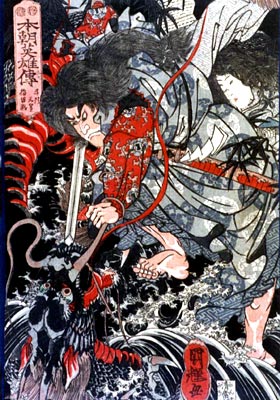
That’s the story, anyway. Of course it only makes sense if one doesn’t think too much about it (as is the case with many religious stories). For those of you who like to use your noggin, here are some questions to ponder with this tale.

Why was a powerful god hiding from a Thunderstorm…especially since he’s supposed to be a Storm God? If he does/did have divine powers, why was he so easily beaten by a mere Vegetable?
  Was a Cucumber the equivalent of Kryptonite to him?  …logic, unfortunately, does not prevail against superstitions (as we all know too well), so even to this day, Cucumbers have absolutely no chance in Adose-Cho.

The town of 60 (<–yep, you read that right!) people (mostly elderly) still has very strict ordinances against this pesky Vegetable to this very day.  Sounds pretty crazy, right?  As one Japanese netizen put it:
“WELL NOW WE KNOW WHAT HAPPENS TO PEOPLE WHO DON’T EAT THEIR CUCUMBERS: THEY GO CRAZY”
So, if you plan on visiting this sleepy little town in Fukui, bring your Camera, your Japanese Phrasebook, and a hearty appetite for adventure… just leave the Cucumbers in the Car.  “Take the Phrasebook, leave the Cucumbers!”.

On the other hand, maybe 須佐之男 had the power of foresight and wanted to prevent his people from eating Luminous Cucumbers in the future.

Filed Under: Culture, History

Reader Interactions

Leave a Reply Cancel reply

Your email address will not be published. Required fields are marked *

Primary Sidebar

YOU MAY LIKE

Kintsugi

Kintsugi: The Art of Embracing Brokenness and Finding Beauty

Imagine dropping your favorite ceramic bowl. It shatters into pieces, and your heart sinks. But what if, instead of throwing it away, you could repair it in a way that not only restores it but also makes it more beautiful than before? This is the essence of Kintsugi (金継ぎ), the ancient Japanese art of repairing broken pottery […]

There’s A Train Station In Japan Built Solely To Admire The Scenery And The Only Way To Access It Is By Train

Japan is small but a scenic country filled with awe-inspiring travel routes and luxurious vessels in which to travel through them. The latest transport design from the unique archipelago comes in the form of a train station sat isolated along the Nishiki River in Iwakuni, with no entrance and no exit. Located on the Nishikigawa […]

16 Common Yakuza Tattoos And Their Meaning

The tradition of Japanese tattooing, known as Irezumi, has been inseparable from the Yakuza from the beginning of time. During the Edo period (1603 until 1868), criminals were tattooed in the hands of authorities using a method called bokkei. They were branded as a criminal using these tattoos back in the day, which made it […]

Homeschooling in Japan

Anyone who’s visited Japan or seen enough Japanese culture can imagine education in Japan is taken pretty seriously. Kids can be seen in uniform from age 4 all the way up to 18 years old. Japan still boasts annually having a 99% literacy rate. There’s a robust after-school industry called “cram schools” cashing in on […]

Hanami: The Timeless Japanese Tradition of Cherry Blossom Viewing

Japan has a long history of traditions and cultural activities. Hanami, or cherry blossom watching, is one of the most popular and widely recognized customs. Hanami is more than just enjoying flowers; it is a cultural celebration that represents the fleeting beauty of life and the start of spring. The activity has strong historical origins […]

  • Privacy Policy
  • About us
  • Contact

Copyright © 2026 · Magazine Pro on Genesis Framework · WordPress · Log in