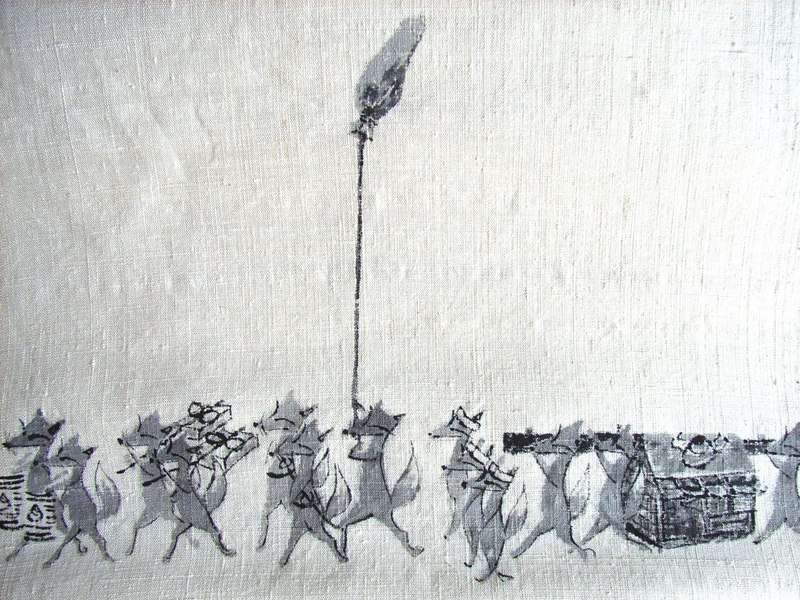
Depending on where you are from, there are various expressions for rainfall on a sunny day. The proper term is “sunshower,” however in the Southern United States you might hear the phenomenon referred to as “the devil beating his wife.” In Japan the phrase kitsune no yomeiri or “The Fox takes a wife”, (or in other regions kitsune no yometori 狐の嫁取りor kitsune no shugen 狐の祝言) is a much more pleasant image, although no less mysterious. Just what do devils and foxes have to do with the weather? While I can’t speak to devils, stories about Fox weddings can be found throughout Japanese literature and art as far back as the 8th century. There are even ukiyo-e prints by Hokusai showing the Fox’s wedding.
There are several related theories as to the etymology of this phrase, but all of them stem from the fox’s role as trickster in Japanese lore. The simplest explanation is that foxes create rain on a sunny day as a way to fool humans and keep them away from the places where foxes are holding their wedding ceremony. But there may be more to it than that.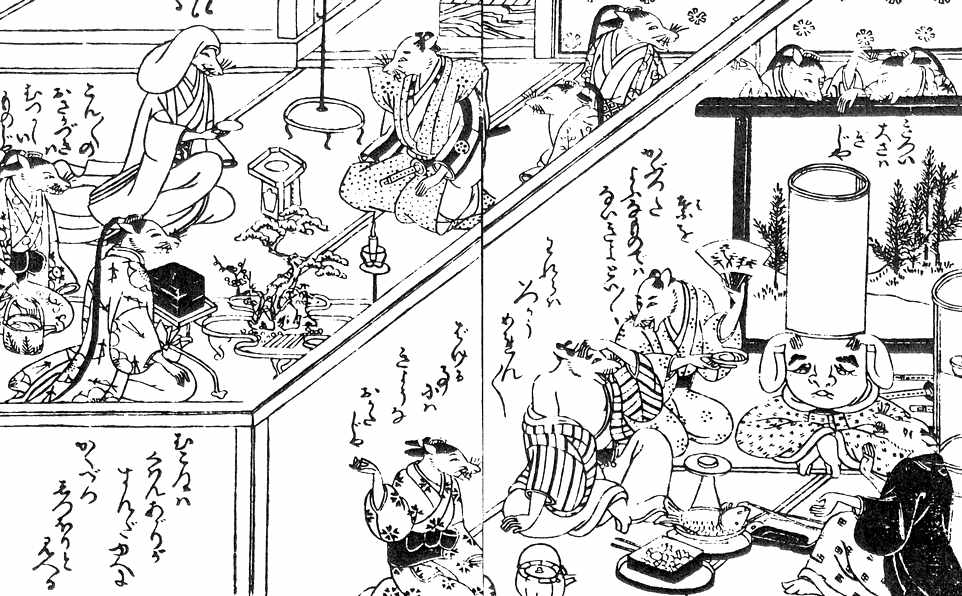 Kitsune no yomeiri can also be used to explain the presence of atmospheric ghost lights, similar to European stories of will o’ wisps. Until the Showa period, Japanese weddings were often held in the evening, and included a lantern procession. It is thought that observers of “ghost lights” might have mistaken them for a wedding, only to find nobody there. Another elaborate ruse by the trickster fox. There is no consensus on what the true cause of these ghost lights might be, but some explanations include light aberrations due interaction with the electromagnetic fields, or chemical reactions of phosphorous to rain water. Some etymologists suggest that an unexplained phenomenon like sunshowers may have seemed similar to these mysterious ghost lights, and thus they simply borrowed the phrase.
As a fan of etymology, what I find much more fascinating is that there are variations of this phrase all over the world, as far away as South Africa, most likely spread by merchants along the silk road. For instance, a quick jump over to neighboring Korea and you will find the phrase “Mr. Tiger marries a fox.” Then you can trace your way down to through South East Asia and the Indian subcontinent and hear people talking about “the fox’s wedding” in Bangladesh, Nepal, Sri Lanka and in over 5 languages throughout India. Venture to the North and you may find versions in Pakistan, Afghanistan, Iran and Algeria in which the “fox” is replaced with a jackal. Still further down the silk road, in Algeria, Morocco – even all the way to France, the phrase can be found, this time with the jackal replaced with a wolf. The phrase even made it’s way to remote Brazil where it is called casamento de raposa, probably brought there by Portuguese merchant ships.
Leave a Reply