It is safe to say that the legend of Momotaro, the story of a boy who was born from a peach, is the most well known fable in all of Japanese folklore. From as early as kindergarten, children are told the tale of the childless old couple that found a giant peach floating in the river, only to open it and find a small boy inside. Most residents of Japan are familiar with the story, yet few people are aware that Momotaro and his cadre of oni-fighing animals are actually enshrined in the city of Inuyama, in central Japan. For those who like B-rank roadside attractions, this one is not to be missed.
There are actually several shrines to Momotaro throughout Japan as well as rival claims to his “birthplace” (if you can call emerging from a giant piece of fruit a birth), but what sets this one apart are the dozens of slightly unsettling statues. Of course there are, and I use this word very loosely, “historical relics” on site such as the washing stone that the old woman was using when she found the peach. There are also “authentic” weapons used by the oni, as well as the mummified remains of an oni, or at least they claim to have had one, only a photo remains now.
But those are not the attractions that lure in travelers. People come to see the somewhat surreal statues, created by concrete artist Shoun Asano (1891-1978). Asano was a bit of a local star, but is almost entirely unknown outside of the Tokai area. His strange concrete statues can also be found at Goshikien in Nisshin City, and Sekigahara Warland, in Gifu. I could describe the statues to you, but words don’t really do them justice.
 A concrete oni statue greets visitors near the first torii gate
 A truly unique feature – a peach shaped torii gate
Near this peach shaped gate, an inscription reads “Momo gata torii o kugureba aku ga saru, yamai ga inu, wazawai ga kiji.” After passing through this peach shaped gate, evil shall leave you, illness will cease to exist, and disaster will not befall you.” This is a play on words, as “saru,” “inu,” and “kiji” refer to his companions, the monkey, dog and pheasant, respectively.
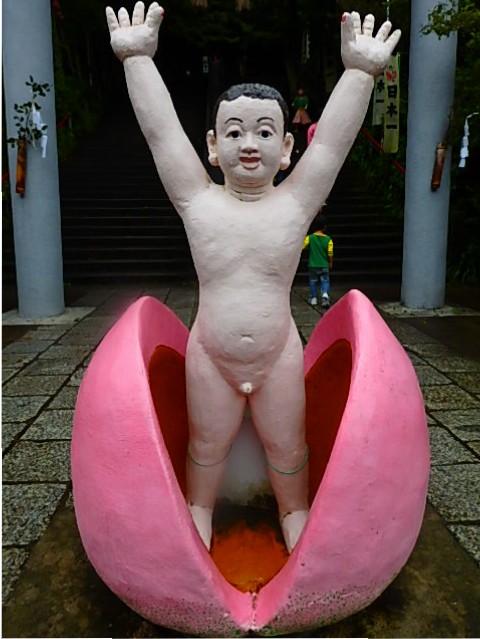 Peach boy himself, Momotaro in all his uncovered glory
 The sign reads: “I will not do bad things anymore. Look at my tears.”
This oni has water dripping from his eyes into the pool of water below, as he shows remorse.
 Several of the prominent characters assemble
 Momotaro’s mother stands near what the shrine claims to be the actual washing stone
 The sign reads “I am a nice oni. Hope on my back!”
There are over a dozen statues not shown in these photographs, lining the hills and steps as you climb toward the shrine at the top. There is also a small museum displaying the aforementioned oni club, and the original peach pit that encased infant Momotaro.
Momotaro shrine is a popular destination for boy’s day, every year on the 5th of May. The shrine is also popular for Shichi-go-san, the traditional rite of passage for 3 and 5 year old boys, and 3 and 7 year old girls. There is a large gift shop selling “kibidango” – the dumplings that Momotaro offered to convince his animal friends to help him fight oni. Just across the street is Momotaro Park, a large field that is popular for barbecues and cheap campsites. The site is quite remote and a bit of a trek from the nearest train station, but is easily accessible by car and for a little taste of the strange, worth the trip.
Leave a Reply