Imagine yourself taking a scenic drive through rural Aomori prefecture. Up ahead you see some road signs for a rest stop, some gas stations, the grave of Christ…wait! Stop the car! Wipe your glasses and give yourself a quick drug test. Nope, your eyes are not playing tricks on you. You have just discovered the number one tourist attraction in the little town of Shingo, Aomori – the final resting place of Jesus Christ.
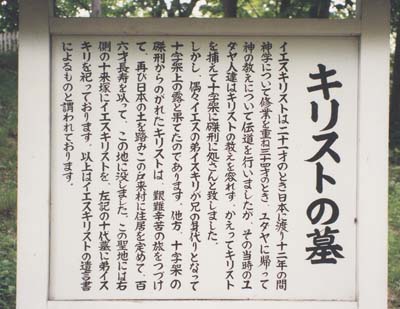
Most people who grew up singing Christmas carols can tell you that Christ was born in the “little town of Bethlehem.” If they are more devout perhaps they could also tell you he died at Golgotha and was entombed at the Holy Sepulchre in Jerusalem. Of course they would be wrong, at least according to an obscure apocryphal collection of writings called the Takenouchi Documents. According to these scriptures, it was not Jesus who died on the cross, but his brother Isukuri – doesn’t that sound like a traditional Hebrew name to you? As for what happened to Christ, he allegedly escaped his Roman captors, fled across Russia and found refuge in northeast Japan where he became a rice farmer until his death nearly 70 years later. He even took a wife who bore several daughters. which means he may even have some descendants running around Japan today. In an article on BBC news, one such descendant, Junichiro Sawaguchi proclaimed “…I don’t claim to be a descendent of Jesus although I know some people have said my grandfather is connected to the legend. Actually, my family are Buddhists not Christians.”
As a matter of fact, for a town that claims to be the final resting place of Christ, there are surprisingly few Christians. According to a report by the Japan Times, there is only one Christian in the whole town, and even she refuses to take part in the annual Christ Festival held near the graves. Although if it is true that Christ was never crucified, then he was never resurrected, which would make the whole religion a sham. This raises the more interesting question of why the grave of Christ would have a cross on it, if in fact the cross had no special meaning for him.
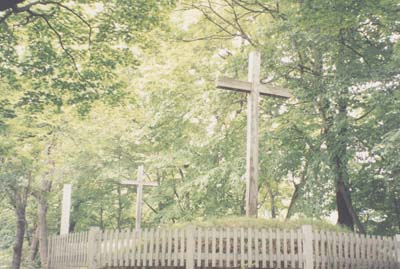
For those who do not have time to go and check this holy spot out for yourself, the site actually contains two graves – one for the body of Christ, and the second contains an ear from his brother Isukuri, as well as a lock of hair from the Virgin Mary, the only relics Christ was able to bring back with him. And yes, I wrote back because it was actually Christ’s second time to Japan. Do you remember those missing years in the Bible between the stories of him as a child and the end of his life? Those were spent in Japan collecting wisdom. And he was not the only one – Buddha, Confucius and Mohammed supposedly spent time training in Japan as well.
THE GREAT HOLY MASTERS OF THE WORLD, MOSES, JESUS, MOHAMMED, SHAKYAMUNI BUDDHA, CONFUCIUS AND LAO-TSU WERE BORN FROM THE FIVE-COLORED RACES WHICH BRANCHED OFF FROM THE JAPANESE RACE AND ALL WENT TO JAPAN FOR STUDY AND TRAINING. – PREAMBLE TO TAKENOUCHI DOCUMENTS
Of course there are some who might call into question the authenticity of such writings. I like to imagine erudite theologians debating the pseudepigrapha such as the third book of Maccabees and one of them sliding the Takenouchi documents across the table. What would they make of the stories of the lost city of Atlantis, or the claims that humans descended from Aliens? The Takenouchi documents, which claim to have been copied from older scripts over 1500 years ago, can be found in a small museum near the graves. Despite the careful protection of generations of priests at the Koso Kotai Jingu in Ibaraki prefecture, the originals were destroyed in the WWII.
If you are one of the lucky people to go and visit this intriguing site, don’t miss the gift shop called “Christop” – a portmanteau of “Christ” and “Stop,” where you can buy souvenirs such as “Kirisuto no hakka sake.” If Jesus’ first miracle was to transform water into wine, perhaps his last was to change water into sake.
Leave a Reply