A few years ago, I was hired to translate for an engineer who was being sent to the US to meet with customers. I imagined it would more or less consist of sitting in boring meetings and looking up a lot of scientific mumbo jumbo in the dictionary. I later found out that, at least in this particular instance, being his translator meant being his guide everywhere he went. That included renting and driving a car.
I reluctantly obliged, but then realized that after nearly a decade of driving in Japan, my state issued driver’s license in the US had expired. Pressed for options, I found myself in the somewhat bizarre situation of obtaining an international license, which is basically a copy of my Japanese license, which was changed over from my US license in the first place, so that I could drive in the US. Luckily the process is dead simple and relatively cheap, so for those who might share in this experience, here is a brief explanation of the process.
What you will need:
1. A copy of your Japanese driver’s license
2. Your passport
3. A 4cm x 4cm photograph (available from the photo-booths at the licensing center, or outside of most grocery stores)
4. ¥2400
Yes that is all. There are no tests written or otherwise, no complicated paperwork to bring, and no need to show your residence card. There is one form to fill out but it is quite painless.
When you arrive at the licensing center, first go to the payment window where you pay for forms. This is usually the same window where you pay to renew your license, or apply for a test. In the case of Hirabiri licensing center in Nagoya, this is window 1. Ask for an international driver’s permit or in Japanese kokusai menkyo(国際免許) or kokugai menkyo (国外免許). After you pay, you will receive a form with stamps on it that are proof of payment.
Filling out the form:
There are several fields you will need to fill out. Essentially you are just going to copy the information off of your license. I have no idea why this is necessary since you will submit this form along with your actual license, but this is Japan and rules are rules. If you are having trouble deciphering what info goes where, here is a detailed breakdown. For people who can read Japanese feel free to skip ahead.
The first three fields are for your address (住所), your name(氏名) and your birth date (生年月日). Keep in mind that your address should match the license, even if you have moved. Since this form will be the basi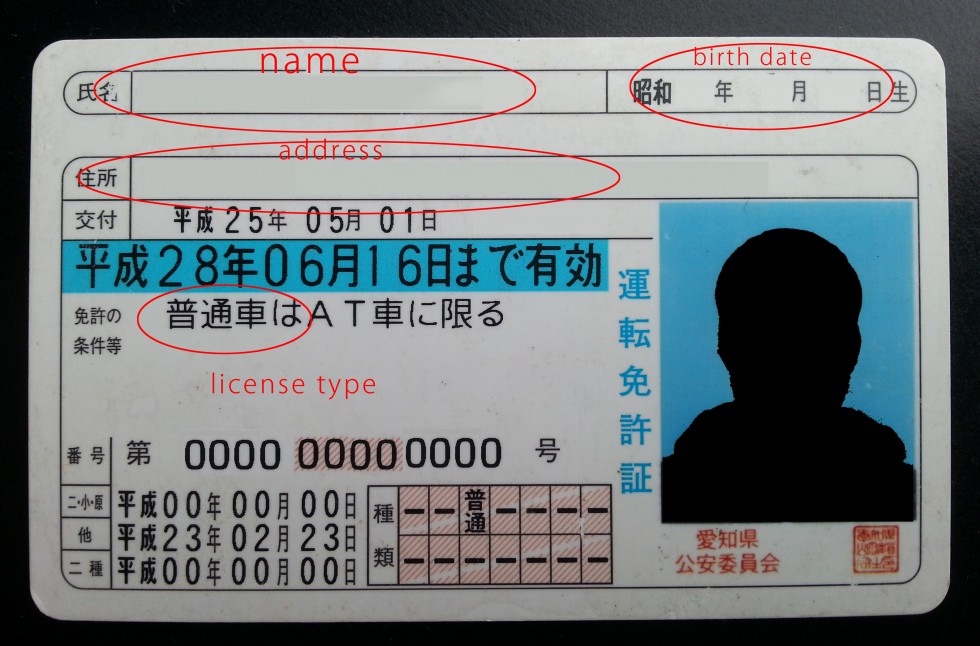 s for how your name is displayed on the international license, you should write your name in alphabet characters.
Your birthday should be written using the Japanese calendar, meaning if you were born before 1989 you will want to circle the character 昭和 and if you were born after 1989 you’ll want to circle 平成. This should be written in the top right corner of your license, but if you are having trouble (or if your license is scratched up like mine) this is a pretty simple calculation – simple subtract 25 from your birth year. So if you were born in 1988, your birth year is 昭和63. For folks born after 1989, you are on your own.
The next field on your form is what sort of license you have. For most people this will be 普通, unless you are going to be driving motorcycles or trucks. The final field is simply asking if you have any amendments to the info on your license (記載事項変更). If all the info on your license is still accurate (no name or address changes) then circle 不.
Once you have your form filled out, you simply take it to the window designated for International Licenses and amendments. In Nagoya, this is window 4. Submit your form along with your passport, your Japanese license and a photo. Once your information has been validated, simply sit down and wait for them to call your name. The whole process can take as little as 20 minutes if the office is not busy. Remember once you are abroad, to carry your Japanese license along with the international permit. You will need both. Also important is that your international license is valid in all geneva signatory countries EXCEPT the country it was issued in. In other words, don’t expect that you can use your international license in Japan in lieu of a Japanese license!
Leave a Reply