The term All-you-can-eat is a cumbersome, mouthful of a word. Buffet is a good substitute, but not entirely accurate as some buffets are not unlimited. My personal favorite is the term smorgasbord, but even that is not always associated with food. If only English had a more concise word like the Japanese word tabehoudai, or the more colloquial Japanese term Viking.
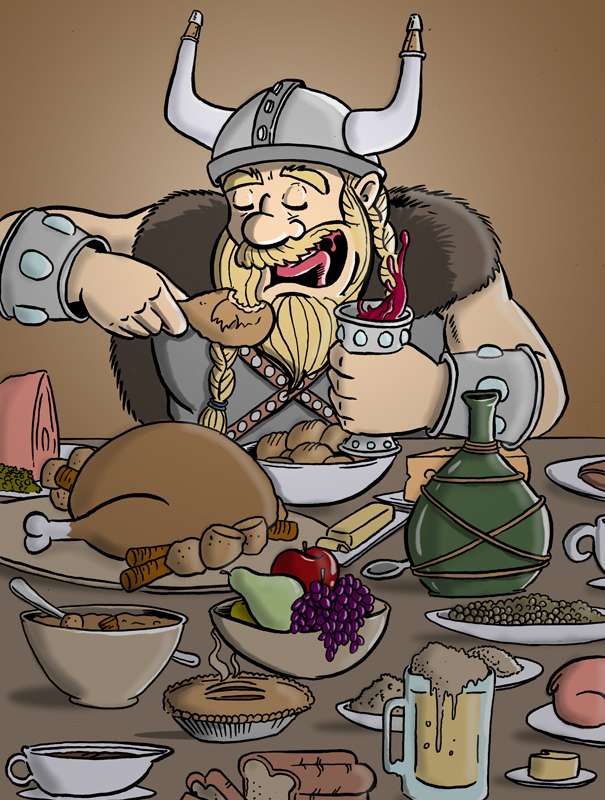
For first time visitors to Japan, use of the word Viking to mean all-you-can-eat is a bit of a head scratcher. Japanese people, often assuming it to be a common English expression, are equally baffled when their invitations to a Viking are not understood. It is pretty clear that the word Viking, used in reference to buffet style dining, is a Japanese original. It’s high time we found out who is responsible for this most bizarre bit of pidgin.
It all goes back to our old friend smorgasbord, or more accurately Smörgåsbord. Before the word became a general catchall for “wide selection” in English, it was a popular Scandinavian meal which gained prominence around the world after the 1939 World’s Fair. It would be another eighteen years before that popularity spread to Japan however, but unlike most fast spreading trends, this one has a patient zero, and we know his name.
Tetsuzo Inumaru was a prominent business leader, most well known for managing the Imperial Hotel in Tokyo for many years. In 1957, Inumaru took a trip to Denmark where he first sampled smörgåsbord, or as it is known in Danish det kold e bord. Upon dazzling his Japanese sensibilities, the businessman in him thought it would be a huge success in his hotel in Tokyo. After training at the Ritz Hotel in Paris, he returned to Japan with big plans for the Imperial Hotel.
After much deliberation with the head chef Nobuo Murakami *and other business associates, it was decided to open a new buffet style restaurant in the Imperial Hotel, however a problem arose in trying to come-up with a name. As fun as it might be to say the word smorgasbord in English, it is somewhat of a tongue twister for Japanese speakers. Not much was known about Scandinavian culture at the time, and Inumaru was having trouble coming up with something that would catch the attention of Japanese patrons. Luckily for him, across the world in Hollywood, California Kirk Douglas was unwittingly creating an answer to all of Inumaru’s problems, in a film called The Vikings (1958).
Although the film is not well remembered these days, it was wildly successful in Japan at the time. Not only did it give Japanese people a cultural touchstone for Scandinavian culture, but it also had a very memorable scene featuring a giant feast. The timing and success of such a film was a marketing dream come true for Inumaru and his team, and riding on the coattails of that film, the Imperial Hotel launched their all new buffet style Baikingu Resutoran (Viking Restaurant) later that year.
There are few things in the world that have the unstoppable power that a Japanese market trend has, and in no time copycat restaurants were springing up all over the country. In no time at all, the term *Viking *became a synonym for all-you-can-eat buffet style dining. You can still see the phrase printed on signs for chains such as Stamina-Tarou to this day. In recent years it has fallen slightly out of favor, but it is unlikely to disappear anytime soon. Just like Kleenex, Xerox and other genericized.
Leave a Reply